

Halekulani Living: "Discovering Kate" Article
An accomplished artist in her own right, Kate Kelly was an invaluable force behind the enduring renown of her artist husband, John Kelly. Read the full article from Halekulani: Living, the official storytelling source for guests of Halekulani Hotel.
Mahalo to Halekulani Hotel's LIVING publication and NMG Network for this stellar story and beautiful photos and layout on Kate Harland Kelly, which highlights her accomplishments as an artist and the influence and inspiration she provided to her artist husband John!

“In 1898, 16-year-old Kate Harland set sail to the Hawaiian Islands from San Francisco on a square-rigged sailing ship with her mother, the women’s suffrage pioneer Hester Harland. The purpose of their visit was ceremonious; the duo had been granted a private audience with Queen Lili‘uokalani. Little did Kate know that a quarter-century later she would be returning to Hawai‘i to make the islands her home and become an accomplished artist in her own right, sharing its beatific landscapes, people, and culture through her sculptures, prints, and photographs.”

Honoring John Kelly on His Birthday
John embraced a cowboy spirit, and throughout his life, was often seen sporting a kerchief in tribute to his roots.
Happy birthday, John Kelly! (1878-1962)
Born in San Francisco on September 24, 1878, John Melville Kelly spent his early years in a small frontier town in Arizona, where his family relocated when he was just six. He had sisters, of which little is known. Growing up amidst the rugged landscape, with a father who was a butcher and ran a cattle ranch, John embraced a cowboy spirit, and throughout his life, was often seen sporting a kerchief in tribute to his roots. This unique upbringing occurred during a time when Native Americans outnumbered settlers, and respectfully living side-by-side with these peoples deeply influenced his perspective and artistic voice. Later, he would connect with Native Hawaiians in the same way, advocating for and sharing their culture through his art.

At 19, John returned to San Francisco to pursue his passion for art at the San Francisco Art Institute, where he honed his skills as a graphic artist—something he had been drawn to from a childhood spent doodling. After graduating, he joined the San Francisco Examiner, where he dedicated 15 years to graphic design before transitioning to an independent career in 1920. Although he ventured to New York seeking new opportunities, he soon realized that the corporate world was not for him, leading him to explore his artistic vision on his own terms in California, and later, Hawaii.

Pālolo Valley Inspiration
Kate Kelly often visited her friends who lived in Palolo, a valley area less than a mile from Diamond Head on Oʻahu, which was also an inspiration for John’s art.
Kate Kelly often visited her good friends Tutu Harvest and Kilikina, who both lived in Pālolo, a valley area less than a mile from Diamond Head on Oʻahu. In the Hawaiian language, pālolo means "clay." Tutu lived with the Kellys for a time, helping with a young John Jr. when his parents were immersed in their art.

This photo depicts the women cooking together in the hills of Pālolo. Left to right: unknown woman, Kate, Tutu and Kilikina.

Kate cooking food over a fire, bowls at the ready.

John did an etching titled “Pālolo Pali,” inspired by the photo below that Kate took of this mountain.

Photo of Pālolo Pali mountain by Kate Kelly
Here is a modern-day map of the Pālolo region, from Google Maps.


John Kelly's Commentary on War, 1942
In the 1940s, John was commissioned by the Navy to produce a poster to encourage Hawaiian men to join the war effort. The Navy rejected this version.
On this Memorial Day, we recognize one of John Kelly’s “failed” works, a piece which never saw its intended usage.
From a critique by Madge Tennent of an exhibit at the Honolulu Academy of Art of John Kelly's work, published in the Honolulu Star Bulletin on October 11, 1942:
“The slumped figure of the tired soldier is a tribute to our Navy and has a Picasso-like certainty of fluid line.”

In the 1940s, John was commissioned by the Navy to produce a poster to encourage Hawaiian men to join the war effort. He did several renditions of the Hawaiian soldier. The Navy rejected his earlier version, depicted here, that clearly revealed the ravages of war.

Fishermen in the Kellys' Neighborhood
In the Kellys' 1930s Black Point neighborhood, some of the people the family had the most interactions with were the local Hawaiian fishermen from the nearby fishing villages, who were their friends and frequent models.

Kimo was a young man who was a favorite model for the Kellys as he grew up - he is immortalized in several photographs by Kate and etchings by John. Photo by Kate Kelly, circa 1930s.
In the Kellys' 1930s Black Point neighborhood, some of the people the family had the most interactions with were the local Hawaiian fishermen from the nearby fishing villages.
Their Hawaiian neighbors named the Kelly home Hale Aloha because of the pāʻina (feasts) they would host, and because of the Kellys' open-door policy. At their home, it was not uncommon to find someone pounding poi, or dancing hula in the backyard. When times were tough (the Kellys depended on intermittent art sales to eat), the fishermen would share their catch with the Kelly family, a generosity which was greatly appreciated and reciprocated. The fishermen Kate took photos of would be given fine art prints as gifts, and in turn, she was granted the opportunity to be a part of the daily lives of her native neighbors.

Amoka was a family friend and sometime model. Photo by Kate Kelly, circa 1930.

“Mapala” by Kate Kelly. Mapala was John Kelly Jr.'s kupuna, mentor, and adopted grandfather. Black Point was his main fishing area. He may have been one of the Hawaiians displaced from Waikiki.

This spear fisherman (name unknown) was a fishermen in the Black Point neighborhood who regularly shared his catch with the Kelly family.

Memories of Mapala: John Kelly Jr.'s Writings of His Kanaka Teacher
John Kelly Jr. writes about Mapala, his Hawaiian kupuna and adopted grandfather, who taught him about the sea.

“Mapala,” by John Kelly
John and Kate Kelly’s son, John Kelly Jr., grew up as a Hawaiian boy, swimming, surfing, diving, fishing, and learning from the neighboring kānaka maoli, Native Hawaiians. This account was written about the man named Mapala, who, as a kupuna, mentor, and the boy’s adopted grandfather, taught John Jr., who he called Keoni, to fish and relate to the sea with respect and a deep reverence.
BLACK POINT, A HALF CENTURY AGO...
by John Kelly
A SMALL WHITE DOG with large worried eyes lingered at the
cave entrance, watching my every move. Warily, she dragged an
empty fire-blackened pot into the cave, a fishbag and her master's
net-patching needles. The cave, situated between two huge basalt
rocks, belonged to Mapala, who went to town to buy rice and tobacco.
I sat down to await his return. A few feet away, the dog faithfully
guarded Mapala's few things, watching me with large sorrowful eyes.
Mapala and I had first met at the moi hole below the cliff-he, an
elder Hawaiian kupuna, and I, a young boy. Returning, Mapala beckoned.
"Keoni," he said, "come tonight when the moon is there," pointing overhead.
"Bring thrownet." The afternoon sun cast its silver glitter on the sea.
When the moon was up there, it was after midnight. Mapala sat
chanting softly before a small fire in the clearing fronting the cave. A
tattered canvas extended the cave's shelter a few feet over the neatly
swept clearing.
"E-hele mai no hoʻi lalo (come sit down)" he said. "Keoni, I wen teach
you how catch moi, patch net. Now, come!" He led me to the cliff overlooking
the sea and our favorite moi hole. "You throw, catch three moi," he said.
How he knew, I'II never know, but after assembling my net, I threw to the
left in the dark waters and caught three large moi. The moi is a silver
migratory fish and a delicacy among Hawaiians.
Mapala wrapped each fish in ti leaves and cooked them in the fire.
He placed one before me, one in front of himself, and the third he set aside.
I ate silently, following his moves, as he chanted on. A warm glow from
the fire pushed back the night. Shadows flickered on the rocks. Moonlight
softened with passing clouds, while breaking waves intoned an ancient slow rhythm from the sea below.
Finally, Mapala arose and took the third fish to the water's edge.
Chanting more strongly, he consecrated the fish to the ʻaumakua (native
god) of the moi and to me, his adopted moʻopuna (grandchild). He then
told me to always remember Hawaiian custom: Never turn your back on the
sea, source of life; when you catch, keep only what you need; return some
to the sea giving thanks; and always share what you have.
The aumakua o ke kai (gods of the sea) will watch over you. "The moi
will follow wherever you go," he said. "And always remember: share with
others."
Mapala taught me all he knew about the sea, the moi, how to spot
their fins in the swirling foam waters of Lae o Kupikipikio (Point of Spouting
Waters, or Black Point). He showed me how to make heavy aho (cotton)
nets with the Hawaiian knot for the rough waters, and light linen nets for
ʻamaʻama (mullet) for inshore reef waters. He knew the comings and goings
of inshore fishes according to moon cycles, tides and spawning seasons. He
showed me where to pick opihi and haʻukeʻuke (limpets), to catch the darting
ʻaʻama (black crab) for uhu (parrotfish) bait.
My father, the artist, made some drawings and etchings of Mapala netfishing
along the Black Point cliffs. When Mapala died, my father made an
etching of his son throwing net left hand at the moi hole below Mapala's cave.
Above, in the cliff overlooking the sea, you can see the visage of Mapala,
ever watching over the well-being of his haole moʻopuna.
Memories remain of my Hawaiian teacher, the generous, knowledgable
and kindly Mapala, Hawaiian fisherman who lived in a Black Point cave a
half century ago...

How the Kellys Were Connected with the Baha'i Faith
John and Kate Kelly’s fascination with the Baha’i Faith, which preaches peace and the unity of mankind, and the art that arose from it.
As an accomplished artist raised in an activist household, it is no surprise that Kate Harland Kelly would be fascinated with the Baha'i Faith.
“The Baha’i Faith began in 1844 in Persia, now modern day Iran. The Prophet-Founder Baha’u’llah was banished and imprisoned for over 40 years for teaching principles to establish peace and the unity of mankind.
These teachings were brought to Hawaii in 1901 by Agnes Baldwin Alexander, a daughter of early missionaries, who learned of the Faith on a trip to Europe. Alexander was the first person born in Hawaii to embrace the Baha’i Faith and Mary Kealiikahumoku Tilton Fantom was the first indigenous Hawaiian to become a Baha’í and to serve in its administration. The Baha’í message was also presented to Queen Liliʻuokalani in 1915, who was interested in its message of peace. There has been a Baha’i community on Molokai since the 1950s.
From 1910-1913, despite ill health, ‘Abdu’l-Baha travelled to Egypt, North America and Europe, where he proclaimed the essential principles of the Baha’í Faith, such as the equality of women and men, universal peace, removal of all forms of prejudice, the harmony of science and religion, and a spiritual solution to economic problems.”
Disciples of Baha'i were, and still are, found on every island in Hawaii. Kate converted to the Baha'i Faith, and it was an inspiration for John as well. His fine, detailed drypoint etching portrait of ‘Abdu’l-Baha depicts the religious leader with depth and skill.

For more information on the Baha'i Faith and Hawaii's branch of the religion, visit bahaihawaii.org.

John and Kate Kelly: The Early Period
1926, John and Kate Kelly's etchings were exhibited for the first time at H.W. Wichman and Co. Here is a newspaper clipping and some of the works from that early time period, when the two artists were just beginning to exhibit.
The Kelly family arrived in Honolulu in 1923. In 1926, John and Kate Kelly's etchings were exhibited for the first time at H.W. Wichman and Co., a purveyor of fine jewelry and clothing in Honolulu. This newspaper clipping of their debut has many positive things to say. "John Kelly's figure studies, particularly those of Hawaiian fishermen and lei sellers, are full of interest and strikingly lifelike, constituting character studies in cleverly etched outlines and shading," writes the columnist.
Here is a newspaper clipping and some of the works from that early time period, when the two artists were just beginning to exhibit.

"Old Lei Seller" was one of John’s early etchings, inspired by a photo Kate Kelly took (right). Notice his attention to detail in the etching, and his faithful reconstruction of the Hawaiian man's pose and garlands,

Here is the other piece mentioned in the article, Kate’s "Royal Hawaiian Under Construction," etched just before the hotel opened in 1927, or late 1926.

Please contact kellyarthawaii@gmail.com if you have any questions, or to make an inquiry!

John Kelly's Bodhisattvas
John Kelly created several detailed and technically difficult Bodhisattva etchings near the end of his life, in the late 1950s. This “Asian period” is probably the least well-known of John’s work, but the results were particularly spectacular.
Inspired by books on Asian art depicting Buddha, Bodhisattva, Quan Yin and other deities, and his wife Kate’s interest in the emerging Baha’i faith (Baha’i opposes war and embraces all of the major spiritual teachings), John Kelly created several detailed and technically difficult Bodhisattva etchings near the end of his life, in the late 1950s. This “Asian period” is probably the least well-known of John’s work, but the results were particularly spectacular, as he brought all the experience of his art career to bear on these subjects.
These five images are a selection of John's Bodhisattva series. The level of detail is particularly spectacular and frankly difficult to imagine that they went through multiple passes on his press.


For more information on the evolution of John Kelly’s technique, see the “Evolution of Technique” page.

Old Kalama and the Kellys
The Hawaiian Kahuna Lāʻau Lapaʻau known as Old Kalama has been immortalized in several photographs and etchings by John and Kate Kelly.

The Hawaiian gentleman known as Old Kalama was locally well-known and widely respected as a practitioner, or Kahuna, of Laʻau Lapaʻau, or Hawaiian herbal medicine. John and Kate Kelly visited him at his home, and he has been immortalized in several photographs and etchings done by the artist couple.

John Kelly is shown visiting Old Kalama at his home in the Palolo area.

Another photo by Kate, circa 1930s, showing Old Kalama at his home
This etching by John Kelly, a detailed likeness of “Old Kalama,” was included in Etchings and Drawings of Hawaiians, by John Kelly, a collection of offset prints published by the Star Bulletin in 1943.


The Iconic Miniature Bronze Works of Kate Kelly
Kate Kelly was the first to popularize small replicas of hula dancers and lei makers, which became iconic souvenirs of Hawaii.
In 1932, when John Kelly quit his job as Art Director at the Star Bulletin to work full-time on his art, Kate had several life-sized busts and plaques already bronzed.


Kate’s sculpture of “Leilani,” a model who inspired both she and John.
To help support her struggling family, Kate produced a series of small, painted figurines for the tourist market. The series includes a lei maker, lei seller and a hula dancer. They were a convenient size to be tucked into a suitcase and taken home by tourists, which added to their popularity. She was the first to popularize these small replicas.


This little hula dancer was cast in bronze for an August 2021 Exhibit honoring hula at Downtown Art Center.

Kate also created two small sculptures of surfers. These miniatures caught on quickly and sold well in gift shops in Waikiki. Some ended up as hood ornaments – one was even sported by Duke Kahanamoku! The series launched what emerged (regrettably) as a trend of dashboard hula dancers, found with frequency on peoples’ cars across the nation in that era.


For more information on the life and work of Kate Kelly, take a look at her full biography.

Historical Plaques by Kate Kelly
The lasting legacy of Kate Kelly includes several historical plaques erected around the islands.
One of Kauaʻi’s most legendary structures is an ancient heiau, or place of worship called the Poliahu Heiau. One of seven built along the Wailua River, it is commemorated by this plaque, commissioned and cast by Kate Kelly, then erected in 1928. The exact wording of the plaque is below:
Historical Landmark Territory of Hawai’i
HEIAU
OF
POLIAHU
ACCORDING TO HAWAIIAN TRADITION,
THIS HEIAU WAS BUILT BY THE
MENEHUNES
(HAWAIIAN DWARFS OR BROWNIES)
IN ITS CEREMONIAL OBSERVANCES,
THE HEIAU OF POLIAHU WAS
ASSOCIATED WITH THE HEIAU OF
MALAE, WHICH IS SITUATED
ON A RIDGE NEAR THE MOUTH OF
THE WAILUA RIVER AND WHICH
CAN BE SEEN FROM ITS PLACE.
TABLET ERECTED 1928
BY SUPERINTENDENT OF PUBLIC WORKS


Another famous plaque by Kate Kelly is located at Diamond Head Lookout on the island of Oʻahu. Cast in bronze by Kate Kelly, it was done in commemoration of Amelia Earhart's first solo flight to Hawaiʻi from California in January 1935. This was the first time a pilot had successfully flown solo to Hawaiʻi from the continental United States.
It was featured on the cover of LIFE Magazine in July 1937, shortly after the famous aviatrix went missing.


A Treasure Trove of Photographs
We are currently digitizing hundreds of extraordinary photographs of Kanaka Maoli (Hawaiian people) taken by Kate Kelly from 1920-1940.
Hundreds of photographs taken by Kate Kelly are now in the process of being catalogued and digitized.
These extraordinary photographs of Kanaka Maoli (Hawaiian people) taken from 1920-1940 are being exhibited for the first time.
Kate’s photos are from a period that was especially difficult for Hawaiian people. They were rapidly losing their rightful land, as well as access to traditional fishing grounds and taro loʻi (fields). This was primarily due to hotel development in Waikiki and military expansion.

Hawaiians were forced to move into outlying areas where access to the ocean resources was more difficult and housing scarce.
Kate also documented Hawaiian women at Aloha Tower selling lei to tourists arriving on cruise lines. This innovative enterprise helped offset the loss of subsistence practices.

“Lei Makers” by Kate Kelly

The Tale of the 'Wolves of Waikiki'
In the 1950s, John Kelly sketched this humorous self-portrait of himself and one of his good buddies.

“Wolves of Waikiki” sketch by John Kelly

"Saturday Afternoon in Waikiki” by John Kelly

"Saturday Night in Waikiki” by John Kelly
In the 1950s, John Kelly sketched this humorous, and somewhat less-than-flattering self-portrait of himself (left), accompanied by one of his good buddies. The little sketch was jokingly titled “Wolves of Waikiki,” but it was done as a study for his very special diptych watercolor of people on the street in Waikiki.
Can you find the two “wolves” in the nighttime version of the diptych? (Hint: John Kelly is wearing green shoes)
John was known for having a great sense of humor about himself and often joked about how he looked.
“Saturday Afternoon in Waikiki” early 1950s watercolor. Original NFS, 10 x 20" Giclee Print $350
“Saturday Night in Waikiki” early 1950s watercolor. Original NFS, 10 x 20" Giclee Print $350
Please contact kellyarthawaii@gmail.com if interested in purchasing.

"How John & Kate Kelly Gave Back to Hawai’i" DAC Gallery Talk Story by Cha Smith
This talk was originally a Facebook Live event hosted on August 14th, 2021 at Downtown Art Center, during the show “Hoʻopuka: To Emerge - The Love of Hula.”
Parts of the artwork addressed in this talk are on view at the Downtown Arts Center gallery for the current show, “Hoʻopuka: To Emerge - The Love of Hula” on view through August 28th. With Cha is curator and photographer Floyd Takeuchi. Mahalo for watching!
This talk was originally a Facebook Live event hosted on August 14th, 2021. Click here to view on DAC’s facebook page.

New Video Introducing Multiple Artists in the DAC 2021 Exhibit “Hoʻopuka: To Emerge – The Love of Hula”.
New promotional film by Floyd Takeuchi, highlighting artists in the upcoming DAC exhibit, “Hoʻopuka: To Emerge – The Love of Hula.”
We are excited to share this video about the upcoming Downtown Arts Center exhibition, by Floyd K. Takeuchi, who himself is a photographer and curator of the upcoming show, “Hoʻopuka: To Emerge – The Love of Hula”. In it, participating artists meditate on their work, and the significance of Hula in our lives, community, history, and for them as artists. Big thanks to Jonah and Marlene, the dynamic duo that run Small Hour Films, which produced the video.
Visit the upcoming art exhibition “Hoʻopuka: To Emerge – The Love of Hula” at Downtown Art Center from August 3-28, Tuesday through Sunday, 11 a.m. to 6 p.m., to see John Kelly's watercolor duo or diptych, “Saturday Afternoon and Saturday Night in Waikīkī” unveiled for the first time!

Cha Smith Interviewed on The Conversation
Cha Smith, manager of the Estate Collection, is interviewed by Catherine Cruz on Hawaii Public Radio’s The Conversation. They discuss the upcoming exhibit at Downtown Art Center in Chinatown, Honolulu honoring hula.
Cha Smith, manager of the Estate Collection, is interviewed by Catherine Cruz on Hawaii Public Radio’s The Conversation. They discuss the upcoming exhibit at Downtown Arts Center in Chinatown, Honolulu honoring hula.

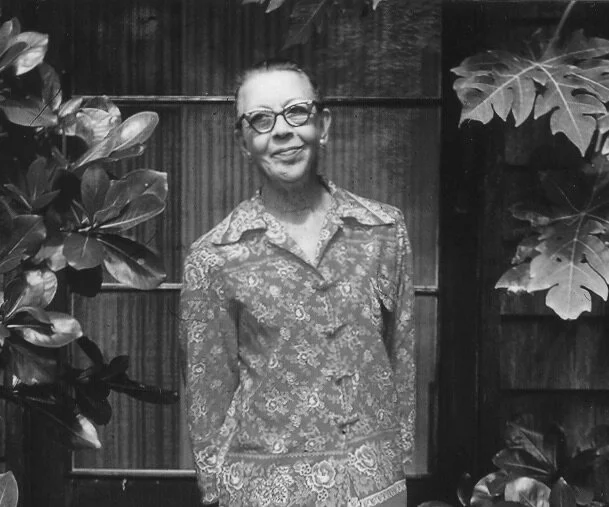
Kate Kelly’s sculpture, etchings and amazing photographs presented for the first time!
Extraordinary photographs of Native Hawaiians in the 1920’s through the 1940’s soon to be revealed for the first time.

Kate was a talented artist who worked in several media. We are very happy to acknowledge this by sharing selection of her etchings, sculptures and amazing photographs.
Three of Kate’s sculptures are housed at the Honolulu Museum of Art. Her plaques can be seen throughout Honolulu.
A treasure trove of photographs is currently being catalogued and digitized. We hope to present an exhibit of her work in a physical gallery here in Honolulu as soon as possible. Kate has documented life in the 1930’s and 40’s- a time in Hawai’i that is rarely seen.
This body of work harkens back to a time when the majority of Native Hawaiian people were being displaced, but still managed to grow food and fish. Hawaiians were also surviving by innovatively selling lei to the increasing numbers of tourists arriving in Hawai’i.

THE DUET PROJECT: Etchings & Photos Paired in Unique Offering
Film director Robert Bates represents a discreet offering of four sets of Kate’s photographs and the corresponding etching by John.

DUETS: Photos that inspired the art.
Film director Robert Bates represents Kelly Art Hawai’i in a discreet offering of four sets of Kate’s photographs and the corresponding etchings by John.
Hawaiian Decoration, a black and white aquatint, is one of the duets being offered.
Inquiries can be made through our contact page.


Wells Blog
Duis mollis, est non commodo luctus, nisi erat porttitor ligula, eget lacinia odio sem nec elit. Maecenas faucibus mollis interdum. Nulla vitae elit libero, a pharetra augue.


Praesent id libero id metus varius consectetur ac eget diam. Nulla felis nunc, consequat laoreet lacus id.